
In an egg tray production line, there’s always leftover scrap paper, offcuts, and defective egg trays. Instead of letting these materials occupy valuable floor space and then be discarded, a baler machine compresses them into compact, easy-to-handle bales, which are then sent back to the paper pulper for reuse as raw materials. This process not only promotes a cleaner and safer workspace but also reduces raw material purchases and lowers expenses.
However, not all balers are built the same. The two most common types, vertical baler machines and horizontal baler machines, offer different capabilities, space requirements, and automation levels. Selecting the right one can make a significant difference in overall efficiency, labor costs, and productivity. In this guide, we’ll explore how these two types work, their pros and cons, and the key factors you should consider before investing.
Vertical Baler Machine
A vertical baler machine is a waste paper compactor that uses a top-down compression system to press recyclable materials such as paper and cardboard into tight bales. The operator manually loads the waste paper into the chamber, and a hydraulic system pushes downward to compress it.
Vertical balers are widely used in small to medium-sized businesses, supermarkets, warehouses, and egg tray production lines that generate moderate volumes of waste paper and waste cardboard. Their upright design requires minimal floor space, making them ideal for facilities with limited areas. They provide a cost-effective solution for businesses seeking a balance between productivity and affordability without heavy automation.
Horizontal Baler Machine
A horizontal baler machine compresses materials horizontally using a hydraulic system that pushes material into a chamber, forming dense bales automatically. Unlike vertical balers, horizontal models are designed for continuous feeding via conveyor belts, allowing uninterrupted operation.
These machines are best suited for large-scale business mode, packaging plants, paper mills, and manufacturing industries that handle high volumes of recyclable waste paper daily. Horizontal balers support a higher degree of automation, offering faster bale production, automatic tying systems, and greater efficiency in processing bulk waste paper. They are the go-to choice for businesses prioritizing speed, consistency, and reduced labor costs.
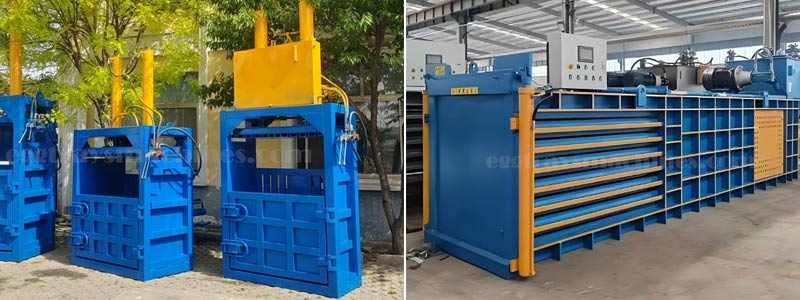
Vertical Baler Machine Vs. Horizontal Baler Machine
Design & Structure Comparison
The most noticeable difference between the two waste paper balers lies in their design and compression direction. A vertical baler uses a top-down compression mechanism, meaning materials are compacted vertically within the chamber. In contrast, a horizontal baler compresses materials side-to-side, using a hydraulic system that pushes waste horizontally into a long bale channel.
Vertical balers are manually loaded, making them simple to operate but slower in handling large volumes. Horizontal balers often feature hopper and conveyor feeding systems, allowing continuous input of materials, perfect for large-scale facilities that require constant operation and minimal downtime.
Automation Level Comparison
Vertical balers are typically semi-automatic or fully automatic because of the requirement of manual loading. Horizontal balers offer a high level of automation. Many models come with automatic bale tying, continuous feeding, and ejecting systems. These features dramatically reduce operator involvement and allow the machine to run almost continuously. As a result, horizontal balers are more efficient in high-output environments, though they come with a higher initial investment.
Output & Bale Size Comparison
Vertical balers produce smaller bales, which are ideal for compact storage and easier manual handling. They’re suitable for facilities generating low to medium waste volumes. Horizontal balers, by contrast, deliver larger, denser, and more uniform bales at a faster rate. With higher compression power and automated output, they handle high-volume waste processing efficiently, providing consistent bale size and density suitable for bulk transportation and recycling efficiency.
Initial Investment & Operating Costs Comparison
The initial investment for vertical and horizontal balers varies significantly due to their different capabilities and automation levels. Vertical balers are more affordable, typically costing less upfront because they are simpler in design and offer basic functionality. These machines are a great choice for businesses with a limited budget or those just starting out, offering a lower cost barrier to entry.
Horizontal balers are more expensive to purchase due to their advanced features, larger size, and higher automation. These machines are a substantial investment, but their increased capacity and automation can provide long-term savings, especially in large-scale operations. The automation reduces the need for manual labor and can streamline processes, which in turn helps to lower labor costs.
When it comes to operating costs, vertical balers tend to have lower energy consumption and maintenance expenses, as they require fewer complex systems. Horizontal balers may consume more energy due to their continuous feed systems and automation, but their efficiency in handling large volumes compensates for this by reducing the need for constant human intervention. Maintenance costs for horizontal balers may also be higher, given the complexity of their hydraulic systems and automated components.
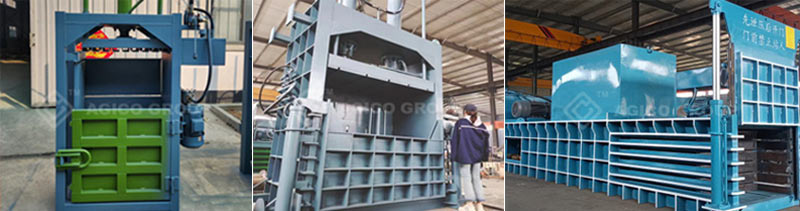
Key Factors To Consider When Choosing
When selecting between a vertical baler and a horizontal baler, several key factors should guide your choice.
Waste Volume
Consider the type of materials you will be baling, paper, cardboard, or other recyclables, as well as the volume of waste generated. Vertical balers are ideal for facilities with moderate waste volumes and smaller materials like paper and cardboard. For high-volume operations or bulkier materials, horizontal balers offer the capacity and speed needed to handle continuous waste flow efficiently.
Available Space & Power Supply
Space availability is another critical factor. Vertical balers require minimal floor space, making them a better fit for smaller or crowded areas. On the other hand, horizontal balers are typically larger and require more room, so they are better suited for facilities with more space. Additionally, horizontal balers may need a three-phase power supply due to their higher energy demands, whereas vertical balers can often operate on standard power.
Budget Constraints & Expected Automation Level
Vertical balers are more affordable, but their limited automation might not meet the needs of large operations. If automation is a priority and budget allows, horizontal balers offer a higher level of automation and greater efficiency in handling waste.
Output Goals & Future Scalability
Think about your future growth. If your business plans to scale up production or handle increasing waste volumes, investing in a horizontal baler can ensure your equipment grows with your needs. For smaller, more stable operations, a vertical baler may be more than adequate.